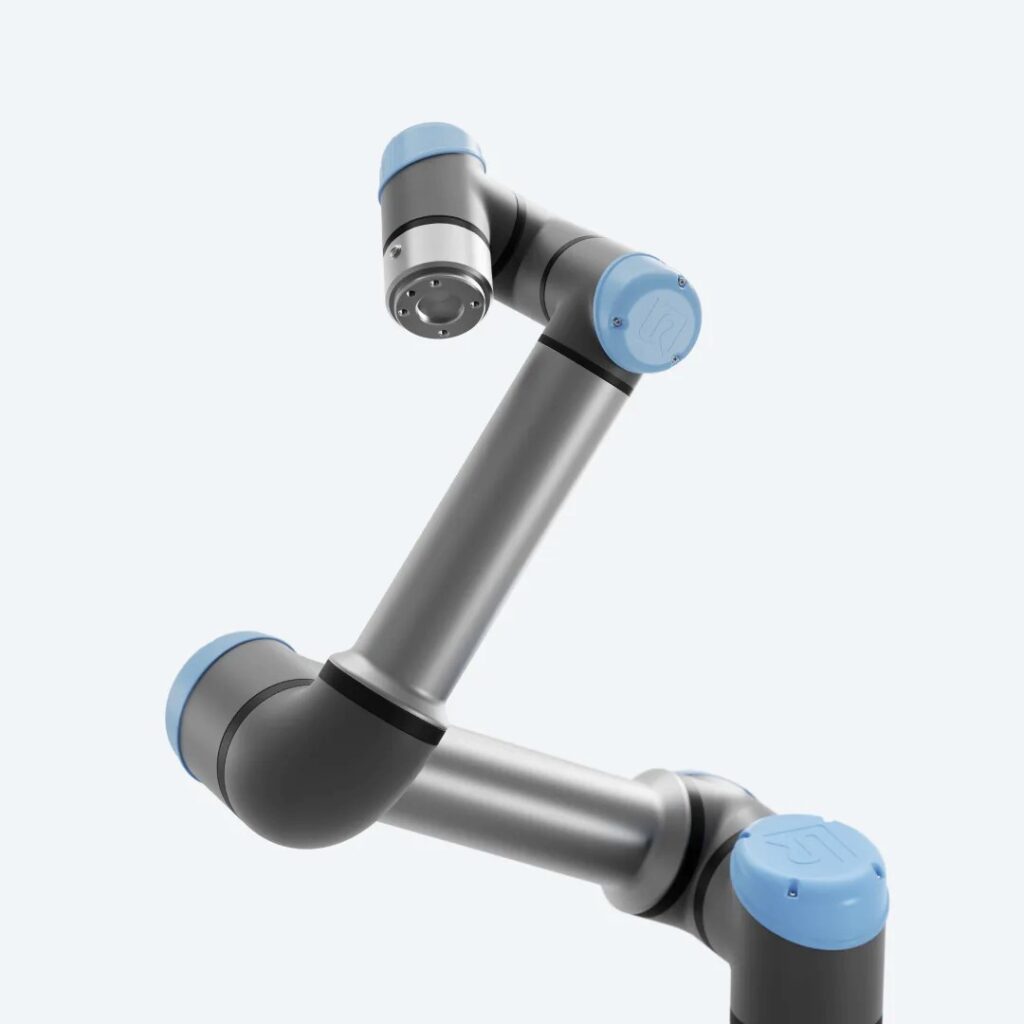
Cobot or industrial robot: quick comparison
| Decision criterion | Collaborative robot | Traditional 6-axis robot |
|---|---|---|
| Operator interaction | Designed for shared-workspace applications after risk assessment | Usually installed inside a guarded cell |
| Speed and cycle time | Moderate, safety-limited motion | Higher speed for fixed, guarded production |
| Changeovers | Fast teaching and frequent product changes | Best for stable, high-volume processes |
| Payload | Strong choice up to the current cobot range | Preferred for higher payloads and demanding dynamics |
| Vertical travel | Both are 6-axis arms. Long vertical travel requires a lift or linear seventh axis. | |
Both Universal Robots cobots and traditional 6-axis industrial robots (KUKA, ABB, FANUC, Stäubli) end up picking, placing, welding, dispensing, or palletizing. The choice between them rarely comes down to capability - both can do most tasks - and almost always to the cell design, the operator-interaction model, and the cycle-time budget.
The case for a cobot
Universal Robots’ e-Series and Polyscope-X cobots are the right choice when:
- The robot shares the workspace with humans. Cobots have inherent collision detection (force/torque on every joint) and can run fenceless after a properly-conducted risk assessment per MD2023. Traditional 6-axis robots require a guarded cell unless heavily modified with safety controllers and area scanners.
- Setup must be intuitive. Polyscope-X programming is skill-based: operators teach poses, select a skill, and run. Compared to teach-pendant programming on a KUKA or ABB, cobot deployment is hours not days.
- Payload is under 30 kg and cycle time is moderate. UR3e through UR30 cover bench-top assembly up to palletizing.
- The line gets reconfigured often. Cobots can be wheeled to a different station with no fence rebuild.
The case for a traditional 6-axis
- Cycle time is the binding constraint. A FANUC or KUKA industrial robot moves significantly faster than a UR cobot of comparable payload, because the safety profile doesn’t impose force/speed limits.
- Payload exceeds the cobot envelope. Above 30 kg or with long-reach tooling, traditional robots remain the only option.
- The cell will run lights-out behind a fence anyway. If no human shares the workspace, the cobot’s force-limited motion is paying a cycle-time tax for safety the cell doesn’t need.
- The integration is welding, abrasive media, or high-IP applications. Specialised wrist designs and protective covers are more mature on traditional robots.
3HLE’s positioning
We are a Swiss Universal Robots Certified System Integrator. Our cobot portfolio covers the full UR e-Series and Polyscope-X lineup - UR3e, UR5e, UR7e, UR10e, UR12e, UR15, UR16e, UR20, UR30 - and we pair each with the right OnRobot end-effector and (for vision-guided tasks) a Sony industrial camera plus Retina A.I. visual decisioning.
If the application genuinely needs a traditional 6-axis robot, we’ll say so during the scoping call rather than force-fit a cobot. Where the application sits on the boundary - say, a 20 kg pick-and-place at 8 second cycle - we benchmark both before recommending.
What to bring to the scoping call
- Part weight and grasp geometry
- Cycle-time target
- Whether operators share the workspace
- Existing or planned safety equipment
- Whether the line is changeover-heavy or stable
With those five answers, we can usually narrow to one robot family within 15 minutes.