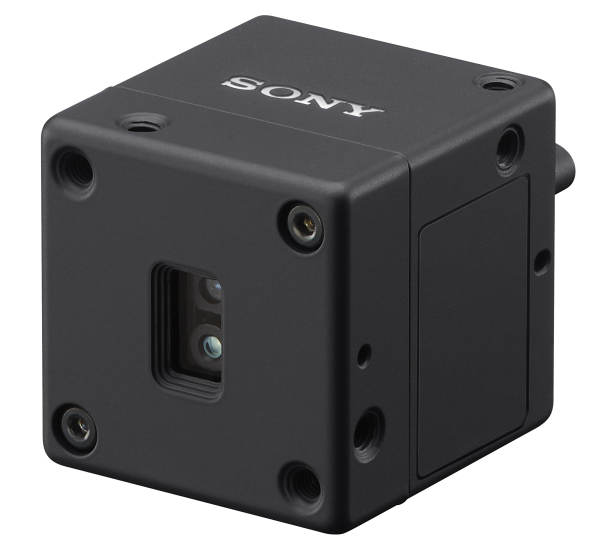
Bin picking - having a robot reliably extract parts from a randomly-oriented bin - is one of the longest-running unsolved problems in factory automation. The technology has finally caught up: with a modern camera, the right structured lighting, and a deep-learning grasp-pose model, bin picking is no longer R&D. But the right approach varies a lot by part geometry and bin condition.
2D bin picking
2D bin picking uses a single industrial camera mounted above the bin to identify parts and compute pick poses in the bin’s surface plane. It is the right choice when:
- Parts lie flat with limited stacking
- The bin is shallow and well-lit
- Part orientation in the camera’s Z axis is well-defined
- Cycle time is paramount and 3D reconstruction would add unwanted latency
A Sony GigE-Vision area-scan camera (the XCG-CG510 family is a common pick) combined with Retina A.I. handles 2D bin picking for most flat-part and semi-stacked cases.
3D bin picking
3D bin picking adds depth information - either through a stereo camera pair, a structured-light projector + camera, or a time-of-flight sensor. Required when:
- Parts are stacked or randomly oriented in three axes
- The bin is deep and parts occlude each other
- The grasp pose depends on knowing the part’s full 6-DOF orientation
- Collision avoidance with bin walls or other parts matters
For 3D bin picking 3HLE typically pairs a Sony industrial camera with a structured-light projector or with the Sony AS-DT1 compact LiDAR depth sensor. The depth-camera choice shapes the achievable cycle time and accuracy.
Structured-light vs ToF vs stereo
Structured-light projects a known pattern (sinusoidal fringes, dot grids, or coded stripes) onto the bin and reconstructs depth from the deformation. Highest accuracy (~50 µm typical), works on most surfaces, slowest cycle time (~1 second per scan).
Time-of-flight (ToF) measures depth from pulse return time. Fastest (~30 FPS), lower accuracy (~1-3 mm), struggles on reflective or transparent surfaces.
Stereo uses two cameras and triangulation. Middle ground on accuracy and speed; works well in textured scenes, less well on featureless surfaces.
The cobot side of the equation
Bin picking almost always pairs with a UR cobot (we typically use UR5e or UR10e for medium-payload bin picking) plus an OnRobot or 3HLE-engineered end-effector matched to the part geometry. The grasp planner needs to know the end-effector’s collision envelope and the bin’s clearance.
What to bring to a feasibility scoping
- A handful of representative parts
- A picture or sketch of the bin (size, depth, material)
- Cycle-time target per part
- Downstream handoff (place-orientation, regrasping, assembly station)
From those, we can usually pick the right 2D-vs-3D path and the right sensor in a one-hour conversation. Working bin-picking cells we have delivered, with associated cycle times and pick-rate numbers, are in the project portfolio.